Monday, May 9, 2011

Cetaceans on the High Seas

Last week, my sister came to visit and it is customary for all of my guests to go whale watching with me. We went out last Monday, May 2. We first saw a gray whale mom and calf. Gray whales pass through our area while migrating south (Starting in December) to mate and give birth and then north (Starting in March) to go back to their Alaskan feeding grounds. The moms and calves are the last to make the journey North. After leaving the grays we saw nothing but blue for a while until a small pod of Pacific white sided dolphins started riding the wake and bow of the boat. This is when the photos actually begin. The first photo is of the dolphins just below the surface riding the wake our boat was making.

 The next photo is of two dolphins riding the wake.
And the third (my favorite of the day) is of the dolphin jumping along side the boat.
 

After seeing the dolphins there was a lot more of simply blue, but we were going somewhere fast. Eventually we caught up with a pod of 6 Orcas (one male, one calf and 4 females). This made my day, because when out whale watching my goal is always to see Orcas.

A female orca with the California coastline in the background (near Santa Cruz)

The male in the group

Three females

The male surfacing

Three of the females (the calf surfaced after this photo, but was in between two of the females)
The person who originally saw the pod of Orcas reported that they were feeding on a pinniped they thought possibly a sea lion, but we didn't see any feeding or post feeding behavior.
The last two photos for today are of birds. First, a Black-footed albatross and second, a gull with a flat fish.

Monday, May 2, 2011

Otters!

These photos are from April 12th in Moss Landing of a gull with a nice treat and an otter in the harbor. He was eating mussels from under the pier.

Gull eating a penaeid shrimp

Otter munching on a mussel

close up of the mussel being eaten

otter eating a mussel

Otter eating a mussel, caught with his tongue out

Eating next to a boat in the harbor

A new month, A new post

So March and April were a bit of a lull for photo taking. I am (like always) a little behind on editing photos, so these are from April 10th in Watsonville. The location is Harkins Slough near the wonderful High-Ground Organics (great strawberries!) I went there to check out the osprey nest, but there wasn't much going on at the nest. I focused on the black crowned night heron (Nycticorax nycticorax, one of my favorite genus/species names) who was checking me out and a cute muskrat (Ondatra zibethicus) swimming in the water.


Monday, April 11, 2011

Where does all the water go?

The lack of posts is due to a few different things- one: it has been dumping rain, foggy and windy a lot this past month (which is not ideal for photography), two: I have had crazy things going on not related to photography- like dealing with moldy stuff, the main artery to Big Sur partially falling into the ocean... and others.

So my take on all of this rain is to take pictures of the 'leftover water.' There are a ton of cute little (and not-so-little) waterfalls around. This photo was taken on Nacimento- Ferguson road on March 30. N-F road is currently the fastest way to get from Big Sur to anywhere north of us. It winds through the Santa Lucia mountains and Fort Hunter Ligget army base. It is a beautiful and slow road. For the first 16 miles it is an average speed of 20 when there is no precipitation. I took this photo near mile marker 4 (4 miles east of the ocean).

(1 sec exp at F22, ISO 100)

Monday, March 14, 2011

A large post for small birds!

Here is the second batch of hummingbird photos. These are from Saturday (3/12) afternoon. I almost filled my 16GB card that day, so editing and choosing my favorites was HARD! Like Thursday's photos, these are Anna's (Calypte anna), Allen's (Selasphorus sasin) and Rufous (Selasphorus rufus) hummingbirds. The Rufous and Allen's are nearly impossible to tell apart, in some cases I was able to make an educated guess and in other cases it was impossible to tell. 
These photos have the same photo stats as the last set of hummingbird photos which is: Canon 7D with 100-400L lens, shooting at ISO 400 and F5.6. 
 

The first set of photos is a really cool event that I did not know about until talking to Feynner this weekend. (And you people thought I knew Everything about hummingbirds!!) The female hummingbirds, I mostly saw Anna's but did see a few orange hummingbirds too, will eat ashes. Feynner said he only observes it during the later winter/ early spring, i.e. nesting time, and suspected that it helps the females produce eggs. I was very curious and looked up some published papers about it and there have been studies that show females (of many species of hummingbirds) will eat ashes during nesting time to get needed minerals. Wood ash is rich in calcium, which could be helpful in egg production. One paper stated that the nesting time is a "high stress" time for females and they loose more nutrients while stressed therefore must consume ashes to regain the lost minerals. So, the next few photos are of female Anna's going up to Feynner's ash pile to eat some ashes. I also took some video (I am an amateur with the video function on my 7D but I think they came out pretty well).
An Anna's hummingbird with a little ash left on her bill
A female Anna's with her tongue out
Another Anna's with her tongue out, you can see the ash on her tongue! (this is one of my favorites)
Two female Anna's fighting over the ashes
Two female Anna's fighting over the ashes (another one of my favorites!)

The next group of photos is a mixture of different hummingbirds in the oak tree they like near the feeders. 
Three female Anna's hummingbirds
Two female Anna's hummingbirds
Because of the green on this male's back I would say this is an Allen's, but there also appears to be a notch in the tail feather and that would mean it is a Rufous with a green back (up to 5% of recorded Rufous have slightly green backs).
This bird is un-ID-able. It could be Rufous or Allen's.
Male Rufous, another one of my favorites!
I think this is a male Rufous but am not 100% sure.
Male Rufous hummingbird
Wait, it's not a hummingbird! This is a dark-eyed junco with something odd on its cheek
The last set of photos is the hummingbirds visiting a Jade bush (Crassula ovata) near the feeder. Jade plants are not native to this area, they are originally from South Africa. They are very popular houseplants because they are easy to maintain. They have small flowers, but the hummingbirds seem to love them, which may just be because it is very close to the feeders.
A male Anna's hummingbird using a makeshift post while feeding at the Jade bush.
A male Rufous hummingbird
A male Anna's and a female/immature Allen's sharing the Jade bush
This is kind of like a where's Waldo, there are 3 hummingbirds here, two male Anna's and an Allen's. Can you find them all?
Anna's and Allen's sharing at the Jade bush
An Allen's hummingbird (either female or immature male)
When you thought it would never end, it finally (sadly) does. Don't worry, these little guys are a short hike away for me and there will be many more photos in the future!

Sunday, March 13, 2011

Little Flying Gems

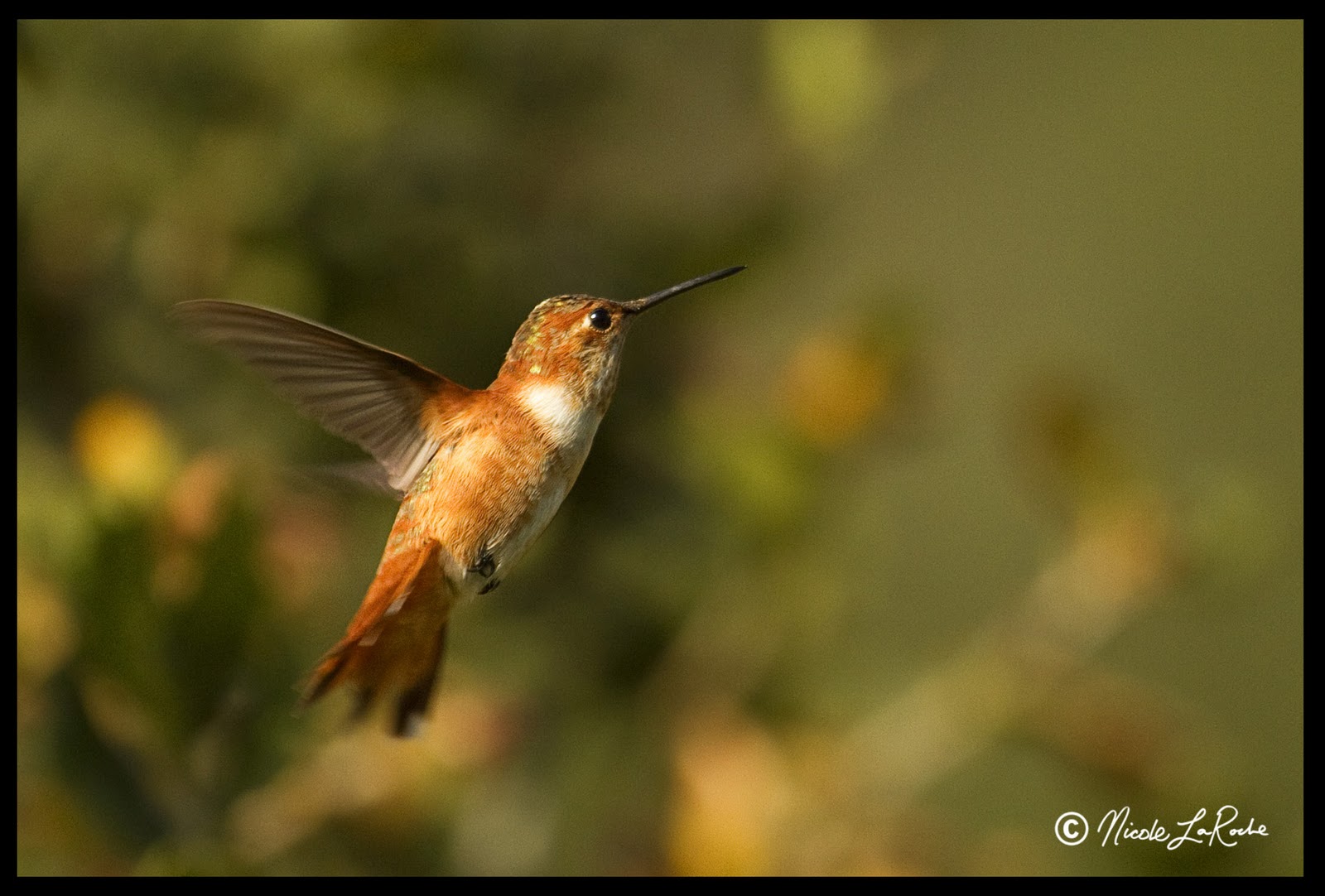
It is hummingbird migration time, and that means they are filling up and getting to nest. In Big Sur, we have Anna's (Calypte anna)and Allen's (Selasphorus sasin) hummingbirds nest and Rufous (Selasphorus rufus) pass through on their way migration route. Anna's hummingbirds are here year round and are the first to nest. I have been searching trees, but haven't found any nests yet (of course I am not invasive, so there may be many I can't find). Allen's and Rufous hummingbirds are very similar and are very hard to tell apart. The males are distinguishable, but the female and immature males look almost identical except some very minor differences in the tail feathers. So, if they do not have their tail feathers spread, it could be either species.
These photos are from Thursday (3/10) afternoon. I was using my 7D with 100-400L lens shooting at F5.6 with iso at 400 (I bumped it up when the sun was starting to set).

Two female Anna's hummingbirds
A male Anna's hummingbird feeding
A male Rufous hummingbird
A female Anna's hummingbird preening
A very talkative male Anna's hummingbird
...More hummingbird photos coming very soon!

Tuesday, March 1, 2011

Get ready for a whole bunch of sea otter photos!

Ok, so it didn't take me a whole day more to post the rest of the photos from the Monterey harbor. There are a lot though! The following shots are of a mom and pup otter foraging. They came up with many different prey items: fat innkeeper worms, crabs, clams and shrimp! We don't get the privilege of seeing otters eat shrimp very often, in fact I have only seen it once other than yesterday. This is what made these photos really exciting for me. They are also in really good light so that helps! 

 
This is the mom eating right in front of a boat


The mom again, she is showing her tags before diving for some more food

This is the mom eating a fat innkeeper worm.

The mom again eating a fat innkeeper worm

Mom with two fat innkeepers and a gull who wants leftovers

Mom with a fat innkeeper worm and a really persistent gull (Mine, Mine, Mine!)

Mom and pup with the gull screaming in the background

This is the pup about to dive

The pup eating a clam that his mom gave up

The pup eating a shrimp

The pup finishing a shrimp off

Mom eating a shrimp

Mom eating a shrimp

Mom gave her shrimp to the pup