Showing posts with label orca. Show all posts

Saturday, November 30, 2013

San Juan Island: Part 3

Welcome back for the third and final part of my trip to Washington in October. The photos today are from the whale watching boat trip I took and the final night driving back down to Seattle.

My biggest hope in Washington was to see orcas. I did get the opportunity to see two transient orcas on the hunt for food while in the Haro Straight. Before we got to the orcas we saw some harbor and dall's porpoises and stellar sea lions. I'll start with the nice weather conditions we had on the water. Below is our boat wake.

I see harbor porpoises a lot in California, but they are really hard to photograph and don't typically make very interesting photographs. There are two harbor porpoise photos below. The first is what you typicallt see. A small triangular dorsal fin for about .5 seconds. Then they are gone. This is why I really like the second photo, which is an adult and calf. They have really odd shaped bodies and are the smallest cetacean. These particular porpoises were riding in the wake of our boat, once again, a rare sight.

Harbor porpoise (Phocoena phocoena)
 A first for me was to get to see Dall's porpoise. They are incredibly fast porpoises who often like to bow ride and surf boat wakes. They are very distict with the frosting tipped dorsal fin seen below. It was great to finally see them in person. 
Dall's porpoise (Phocoenoides dalli)
Below are the rest of the photos from the trip leading up to seeing orcas. The two orcas that we saw were a male and female transient pair who are seen often in the straight. We didn't get to spend too long with them, but since they were hunting while we were around them, they were very quiet (they put a hydrophone in the water) and didn't do any playful actions such as breaching, spy hopping, or tail slaps. They are still a sight to see.

Common murre (Uria aalge) father and chick. Males teach the baby how to fish.


Lime Kiln state park lighthouse
Bald eagle (Haliaeetus leucocephalus)
Male transient orca (Orcinus orca)
Orca (Orcinus orca)
Male orca (Orcinus orca)
Orcas (Orcinus orca) in Haro Straight

On our way back to Friday Harbor, we took some time to stop and check out the unusual ungulates at Spieden Island. Spieden Island is a privately owned island that was stocked with exoctic deer, sheep, antelope and goats. We saw fallow deer (Dama dama) and Mouflon sheep (Ovis orientalis). We also saw a bald eagle and some harlequin ducks (Histrionicus histrionicus).
Fallow deer (Dama dama)

Fallow deer (Dama dama)

Fallow deer (Dama dama)

Bald eagle (Haliaeetus leucocephalus)

Bald eagle (Haliaeetus leucocephalus)

Bald eagle (Haliaeetus leucocephalus)

Harlequin ducks (Histrionicus histrionicus), the males are brightly colored and the females are brown.

Harlequin ducks (Histrionicus histrionicus)

Harlequin ducks (Histrionicus histrionicus)
Finally for the last two photos of the trip, I leave you with Mount Rainier at sunset (taken on the ferry back to Anacortes) and Seattle at night (on the ferry from Seattle to Bainbridge Island).
Mount Rainier

Seattle skyline


Tuesday, December 27, 2011

The last post of 2011

On December 23rd I got to see something that I have been wanting to see for years. It was at the top of my "to see" list. I saw an attack on gray whales by a pod of orcas. There were 4 orcas (and one was a calf) and 2 adult gray whales. The numbers were certainly in favor of the grays and they did win the battle.

I was working at the North end of our study range at Sea Lion Cove and waiting for a sleeping otter to show me her flipper tags. She was dead asleep and I figured I would be there a while so I pulled my camera out to take some hummingbird photos. (previous posts have photos of hummingbirds from this very spot!) While looking offshore I was thinking to myself, this feels like and orca kind of day. The ocean was flat and you could see for miles. About 5 minutes after I thought about the orcas I saw some splashing close to shore. I looked down and saw 2 gray whales on their backs. I thought maybe they were mating. Although most grey whale mating behavior happens far south of us in Baja Mexico, I have seen mating along their travel route a few times.
I started taking some photos of them and then realized there was a dolphin dorsal fin right by the gray's head. I looked a little closer and saw the white saddle patch (a telling characteristic of orcas). I kept taking photos, but was so excited that I was jumping up and down and actually for once, hoping that tourists would stop and I could tell them what was going on. The encounter only lasted about 7 minutes and the orca pod started swimming south and offshore. The grays were underwater for a long time and appeared to 'wrangle up' some more whales that were on their way south. Soon there were 5 grays all swimming together within 200 meters of shore- often through the kelp. Just south of their current location is a deep canyon and this is where it would be easiest for orcas to attack. Often when the mothers and calves are traveling north there are attacks in the deep canyons off Monterey and Carmel.

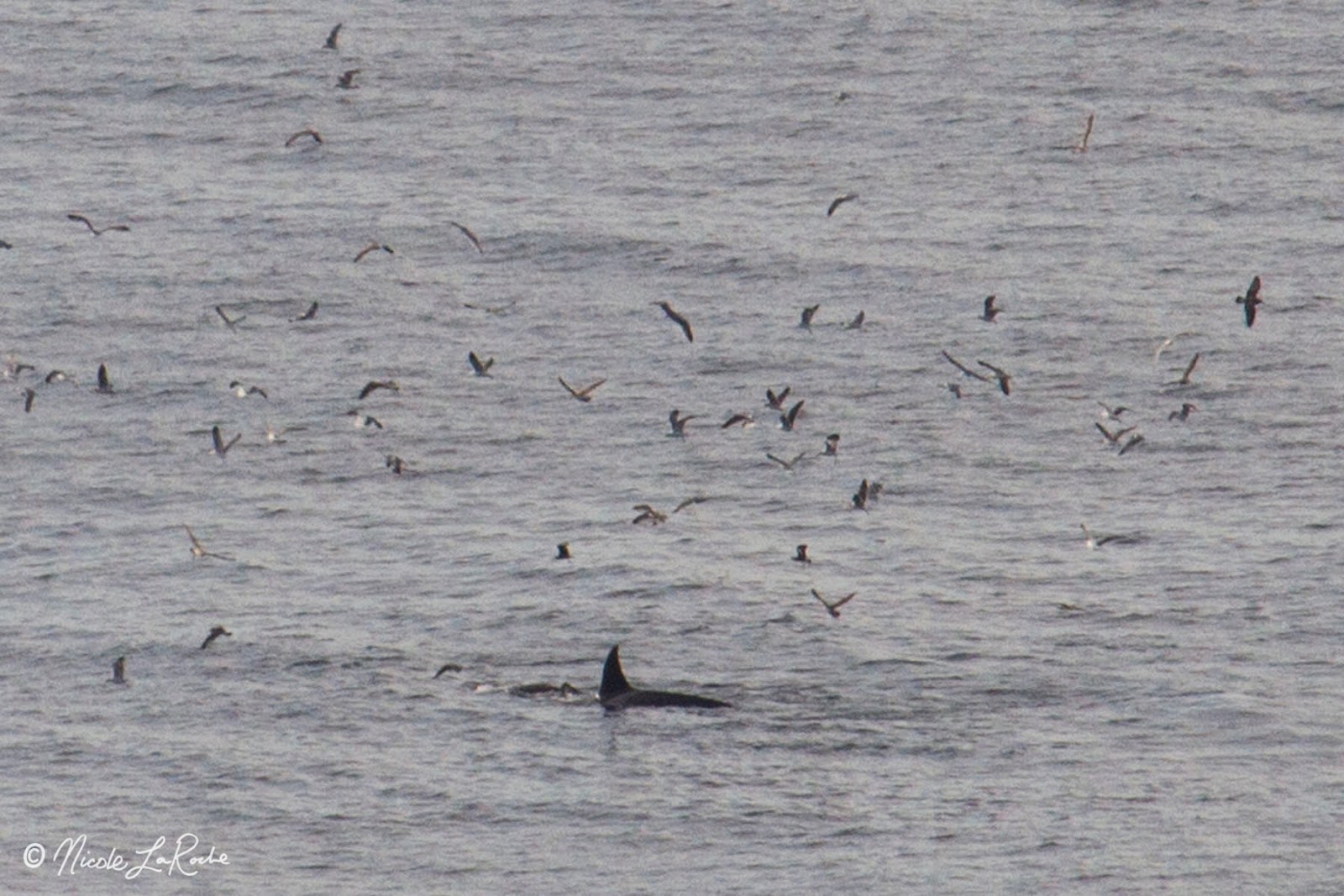
After the orcas swam offshore, I believe they got a sea lion (a little easier breakfast option that a 40 foot long gray whale) and I took some photos but at this point they were about a mile offshore so the quality is not as good.

Gray whale on its back with orcas swimming underneath.
Mom and calf orca on the left side, one orca underwater and the gray whale coming up for air.
Mom and calf orca on the left, two gray whales up for air.

gray whale spouting

gray whale fluke.
After the attack the grays started back south but were swimming very close to one another and close to shore.
Orca breaching (about a mile offshore)

Orca slapping her tail.

Orca- Possibly with a sea lion, they were about a mile offshore of Torre canyon.

Sunday, July 10, 2011

Glacier Bay, Alaska: Part 3

Here is another round of photos from Glacier Bay. This round is mostly from 2 events on 2 days. The first is when I saw orcas (Killer whales, Orcinus orca) passing through the bay. We saw them in the central bay and then again when we were going back to the dock in front of Young Island. It was the only orca sighting of the trip, but I was told day after day (In Glacier Bay, Juneau and Ketchikan) that they were around.
Mom and calf orcas in front of Sita reef

Female orca in front of Young Island

Two females in front of Young island

Female in front of Young island, on the far left the male is about to surface, he had a crooked dorsal fin.

 The next series of photos is of a juvenile female sea otter who was eating mussels and urchins near Geikie rock in the upper central bay. Jessica and I collectively got data on her, but Jess was nice enough to take over so I could get some photos. She was only about 20-30 feet from us collecting her prey from the very reef we were standing on. This is also the same otter from the previous post (I had only edited one photo of her batch at the time).
Eating some really small green urchins.
Finishing up her small prey.

Checking out the surroundings before diving for more urchins.
There are so many captions I could put here....

Eating a very tiny green urchin.
 And for the last photo.... The wildflowers were amazing this trip. The following photo is on Link island in the Beardslees (no boat access so the only way in is to kayak) in the lower bay area. There is mostly Lupine and Indian paintbrush (red, orange and yellow) and seeing an entire field was breathtaking- I don't think the photo does the scenery justice!


Since I have been talking about Glacier bay and the different spots I was at, I thought I would add a map (from Lonely Planet's website) of the area. Bartlett Cove is "the dock" where our boat, the Lutris 2, called home. Gustavus is the town (9 miles from the dock) one would fly into, get pizza and also was where I stayed for part of my trip. I break Glacier Bay into 4 general regions: The west arm (the west arm stretches right up to Canada),  the east arm, central bay (everything in the middle of the bay) and the lower bay where Bartlett Cove is. Hope this helps a bit!